A Career Pivot, Not a Downgrade
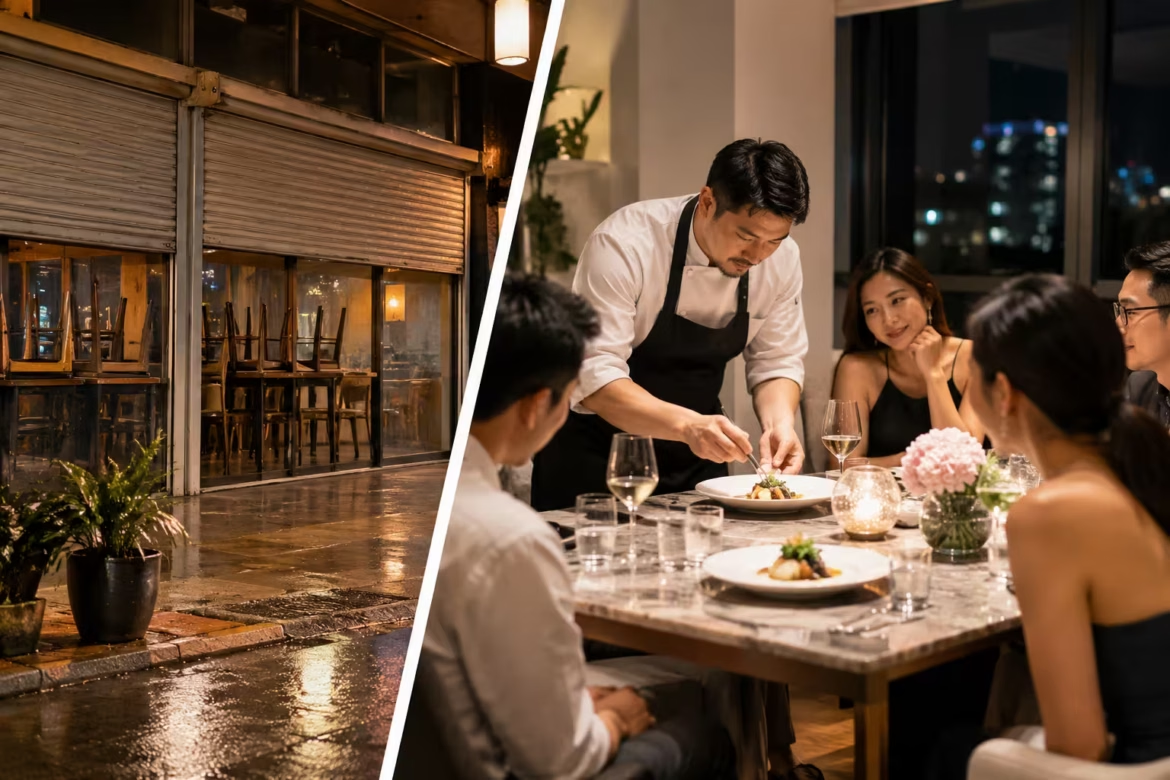
The most telling signal about Singapore’s private dining sector is not the waitlists—it is the résumés. The chefs driving the trend are not self-taught enthusiasts testing the waters. They are trained professionals who have chosen residential intimacy over restaurant scale.
Consider Journe, slated to launch in late June 2026 from a Fernvale flat. The husband-and-wife team, Guah Lih and Ethel Koh, trained at the Culinary Institute of America Singapore before working in Michelin-starred California kitchens—Lih at O’ by Claude Le Tohic, Ethel as pastry sous chef at Quince. Lih subsequently served as chef to the US Ambassador to Singapore from 2022 to 2025 . Their private dining menu will move through “chapters” of exploration, beginning with Singapore and the surrounding region, paired with sake and rice-based alcoholic pairings .
Similarly, Solstice Experiences in Joo Chiat is run by Darren, a Shatec pastry graduate who previously operated a tiramisu brand and worked at the home-dining concept No Burn No Taste before opening his own six-course, $158-per-head concept with seating for eight .
What Restaurant Training Brings to the Home Table
The technical discipline is visible in the output. Journe’s chefs bring pastry precision to savoury courses. Solstice’s Darren applies trained pastry technique to a menu of Asian classics with Western inflection—seafood carpaccio tarts with house shiso oil, barramundi with beurre blanc and laksa leaf oil, and a tableside tiramisu finale . At Kanves, Ethan Khoo’s local roast duck undergoes a 24-hour brine, five-day dry-age, and hay-smoking in a pot before service .
These are not dinner-party dishes. They are restaurant-grade productions executed in domestic kitchens with residential equipment, for eight to twelve guests at a time.
The Operational Reality
The shift from restaurant to home is not without friction. Home-based F&B operators cannot employ staff outside the household, which means the chef is also the server, dishwasher, and host . Capacity is capped by physical space and regulatory definition. And unlike restaurants, which build revenue through volume and table turns, private dining earns through price-per-head and exclusivity.