Singapore’s youngest medical school, the Lee Kong Chian School of Medicine (LKCMedicine) at Nanyang Technological University, has built a curriculum that, from the very start, instills digital literacy and a patient-centered approach. Its partnership with the National Healthcare Group (NHG) allows students to touch the clinical world without waiting for the pre-clinical years to end.
Redefining Anatomy Education with 3D and Virtual Reality
LKCMedicine no longer relies entirely on cadavers. Its anatomy laboratory is enhanced by 3D digital dissection tables and virtual reality simulations that allow students to dissect body structures layer by layer interactively. The NTU LKCMedicine Annual Education Report 2026 confirms that 100 percent of first-year students have used VR modules to study neuroanatomy and basic surgical procedures. [Data source: https://www.lkcmedicine.ntu.edu.sg/] This shift not only increases self-study hours but also improves spatial understanding by up to 30 percent based on internal surveys.
Early Longitudinal Patient Journeys: The House System
To cultivate empathy and social awareness, LKCMedicine implements a House System that guides students to follow the journey of a single family with a chronic disease—from diagnosis, therapy, to psychosocial support—over two years. Students visit the patient’s home, interact with caregivers, and understand socio-economic barriers. This longitudinal approach produces reflective portfolios highly valued during residency interviews.
Technology-Enhanced Diagnostic Training
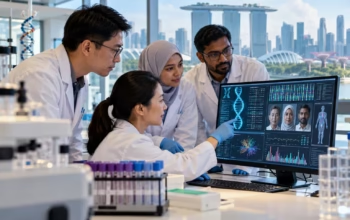
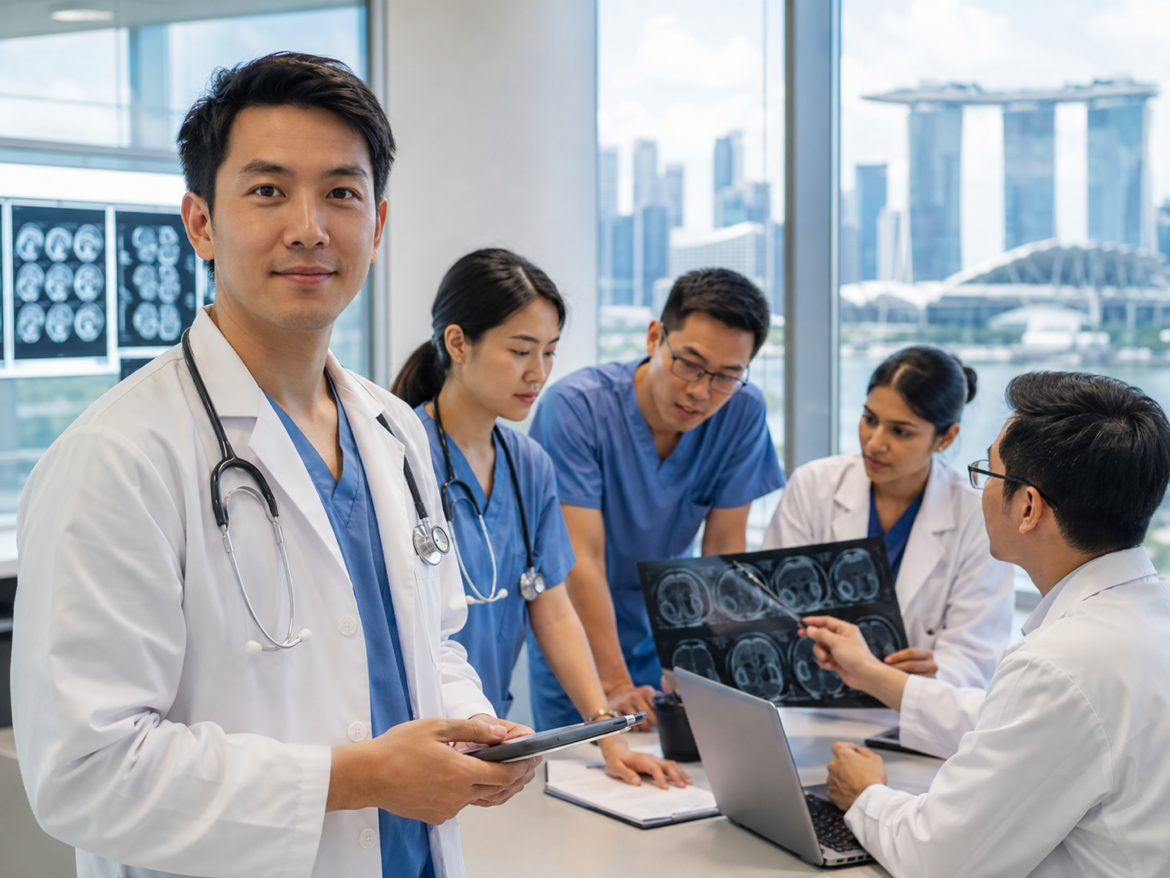
Beyond VR, students train with AI diagnostic applications that analyze chest X-rays and fundus photographs. Under supervision, they compare their interpretations against the algorithm, learning to recognize both bias and the strengths of digital tools. This module equips them for a future clinical world increasingly driven by artificial intelligence.
Community Health Immersion: From Yishun to the Heartland
LKCMedicine’s clinical campuses are spread across various NHG facilities such as Khoo Teck Puat Hospital and community centers. From their second semester, students engage in mobile health screening at HDB void decks and nursing homes, performing blood pressure and glucose measurements, and providing nutrition education. The data collected becomes material for community-scale research, with results presented to primary care physicians. In this way, students witness firsthand the social determinants of health and the management of chronic diseases in the elderly population.
Interprofessional Simulation for Crisis Management
Full-scale simulations involve medical, nursing, and paramedic students in emergency scenarios such as mass casualty incidents or cardiac arrest. Such exercises are recorded and dissected together, instilling closed-loop communication skills and decision-making under pressure.
The combination of immersive technology, long-term patient accompaniment, and multi-professional collaboration produces LKCMedicine graduates who are fluent in working within an integrated health system and ready to adopt any innovation their patients require.