When a Bed Becomes a Ticket Add-On
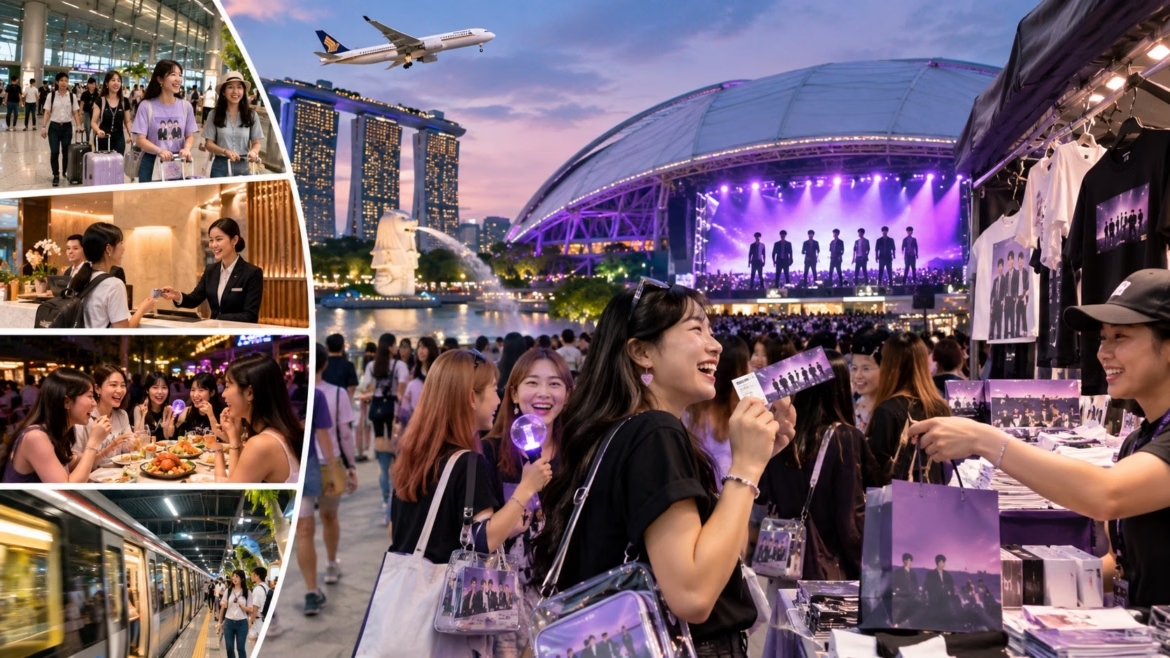
In the fan economy, a hotel room is no longer just a place to sleep. For international concertgoers, it is part of the pilgrimage. And in Singapore, hotels have learned to price it accordingly.
The December 2026 BTS concerts at the National Stadium offer the sharpest illustration. Trip.com recorded hotel booking volumes for the concert period rising more than 18 times compared to the previous year, with roughly half of all reservations concentrated in four-star properties and another 20 percent in three-star hotels . The three-star segment alone saw booking volumes increase nearly 50-fold .
The Geography of Fan Accommodation
Fan spending clusters in specific neighbourhoods. Trip.com data shows that Bugis and Kampong Gelam accounted for nearly a quarter of all room bookings during the concert period, a reflection of their proximity to the National Stadium via public transport and their density of mid-range accommodations . Visitors came primarily from China and Japan, followed by Southeast Asian markets, mirroring the broader regional travel patterns that Singapore’s concert strategy has cultivated .
Operational Strain and the Swiftian Precedent
Hotels are not passive beneficiaries. The Ascott’s regional director of revenue management, Genevieve Khua, noted that the Taylor Swift Eras Tour in 2024 provided a critical operational lesson: concertgoers often book one- or two-night stays, creating extremely high turnover rates that strain housekeeping, front desk, and engineering teams . For BTS, properties are pre-emptively adding staff across multiple departments and preparing BTS-themed amenities and merchandise for guests .
The Ceiling of Pricing Power
Not all fans accept the rate surge quietly. Social media discussions among international fans have floated alternatives: staying across the border in Johor Bahru or spending the night at Changi Airport to avoid hotel costs . This friction points to a structural tension in Singapore’s fan economy: the same scarcity that drives revenue also creates price sensitivity that can push marginal spenders toward lower-cost substitutes. For hotel operators, the calculus involves balancing short-term rate maximisation against the risk of alienating the very fan base that makes the concert economy viable.
The hotel room, in this context, is a financial instrument as much as a hospitality product. Its value fluctuates with artist announcements, ticket sale dates, and the geographic origin of the fan base. Singapore’s hotels have become active participants in the fan economy, not merely its landlords.