The Rise of Immersive Brand Worlds
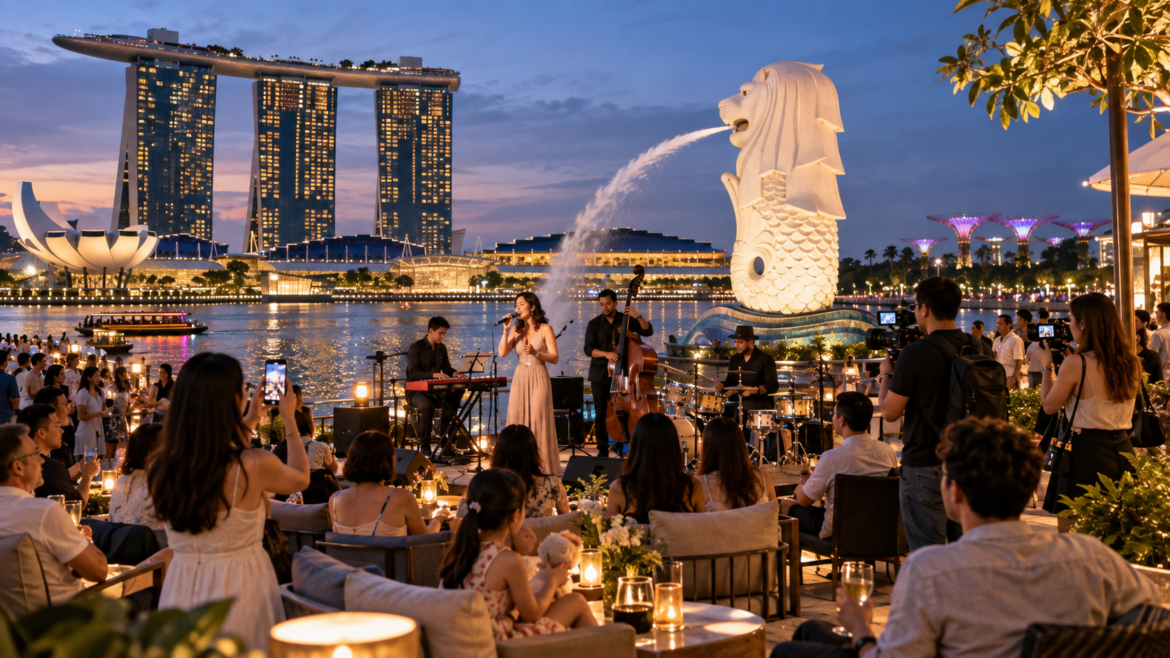
Branded entertainment in Singapore has moved well beyond product placement and sponsorship logos. The city-state’s most innovative campaigns now create fully realised experiential worlds that blur the boundaries between marketing, hospitality, retail, and tourism. This isn’t simply a matter of adding themed décor—it represents a strategic reimagining of what a brand experience can be, where the audience doesn’t just consume content but inhabits it.
The Baby Shark Hotel Takeover
Consider Fairmont Singapore’s collaboration with the Singapore Tourism Board and The Pinkfong Company, which transformed the hotel into an immersive Baby Shark-themed family experience running from May to November 2026. Billed as a Singapore-first, the activation reimagines every touchpoint of the guest journey—from check-in to poolside dining—through the lens of the globally recognised children’s entertainment brand.
The experience includes themed rooms, exclusive keepsakes such as a “Little Explorer” tote bag and collectible plush featuring Baby Shark, Merli, or Pakcik, and a dedicated TV channel streaming Baby Shark content. The Eight, Fairmont’s poolside restaurant, has been transformed with a Baby Shark-themed menu featuring dishes like “Chomp & chips,” “Ooey gooey mac & cheese,” and “Lion city crunch satay”. Interactive activities include cupcake-decorating workshops and meet-and-greet sessions with both Baby Shark and STB’s Merlion-inspired mascot Merli.
What makes this activation instructive is its integration of local and global entertainment IP. As Robert Strasser, hotel manager at Fairmont Singapore, explained, the partnership “integrates Merli alongside our own mascot Pakcik—and it is this combination that makes it distinctly Singaporean, not just another licensed activation”. The campaign doesn’t simply import a global brand; it localises it through collaboration with Singaporean creative assets and the tourism board’s own entertainment properties.
Retail as Entertainment Destination
The branded entertainment model is equally visible in Singapore’s retail sector. The CRYBABY Cry Me an Ocean activation at Resorts World Sentosa’s Singapore Oceanarium, running from June to August 2026, brought POP MART’s beloved character into a marine setting for the first time, with 11 themed photo zones spread across one of the world’s largest oceanariums. The activation demonstrates how retail brands can leverage physical spaces to create entertainment experiences that drive foot traffic and social media engagement simultaneously.
Similarly, Suntec City‘s SG60 activation, recognised at the Retail Asia Awards 2026, transformed the mall into a cultural playground through large-scale food-themed installations. The recognition underscores the commercial value that Singapore’s retail industry places on experiential, entertainment-driven marketing.
The Economics of Experiential Entertainment
The expansion of branded entertainment in Singapore is supported by broader market dynamics. The city-state’s out-of-home (OOH) and digital out-of-home (DOOH) advertising market was valued at USD 194.39 million in 2025 and is projected to reach USD 277.78 million by 2031, growing at a CAGR of 6.13%. While experiential activations are not exclusively OOH, they share the same logic: capturing attention through physical presence and creating moments that audiences want to document and share.
The influencer marketing data reinforces this trend. With 49% of Singaporeans more likely to engage with influencer-led short videos and 45% more likely with interactive ads, there is clear consumer appetite for content that invites participation rather than passive reception. Immersive brand experiences capitalise on this appetite by creating environments where every guest becomes a potential content creator.
The Strategic Logic
What distinguishes Singapore’s branded entertainment leaders is their understanding that the most effective marketing doesn’t feel like marketing at all. When a family checks into a Baby Shark-themed hotel room, they’re not being advertised to—they’re living inside a story. When a visitor to the Oceanarium encounters a CRYBABY installation, they’re not seeing an ad—they’re participating in a cultural moment.
This distinction matters because it addresses the fundamental challenge facing all advertisers in a saturated media environment: how to capture attention without triggering avoidance. The answer, increasingly, is to create experiences so engaging that the audience doesn’t perceive them as advertising at all. In Singapore, this principle is being applied across hospitality, tourism, retail, and beyond—with results that suggest branded entertainment is no longer a niche tactic but a core strategic pillar.